
&w=3840&q=75)
&w=3840&q=75)
&w=3840&q=75)
&w=3840&q=75)
&w=3840&q=75)
&w=3840&q=75)
&w=3840&q=75)
&w=3840&q=75)

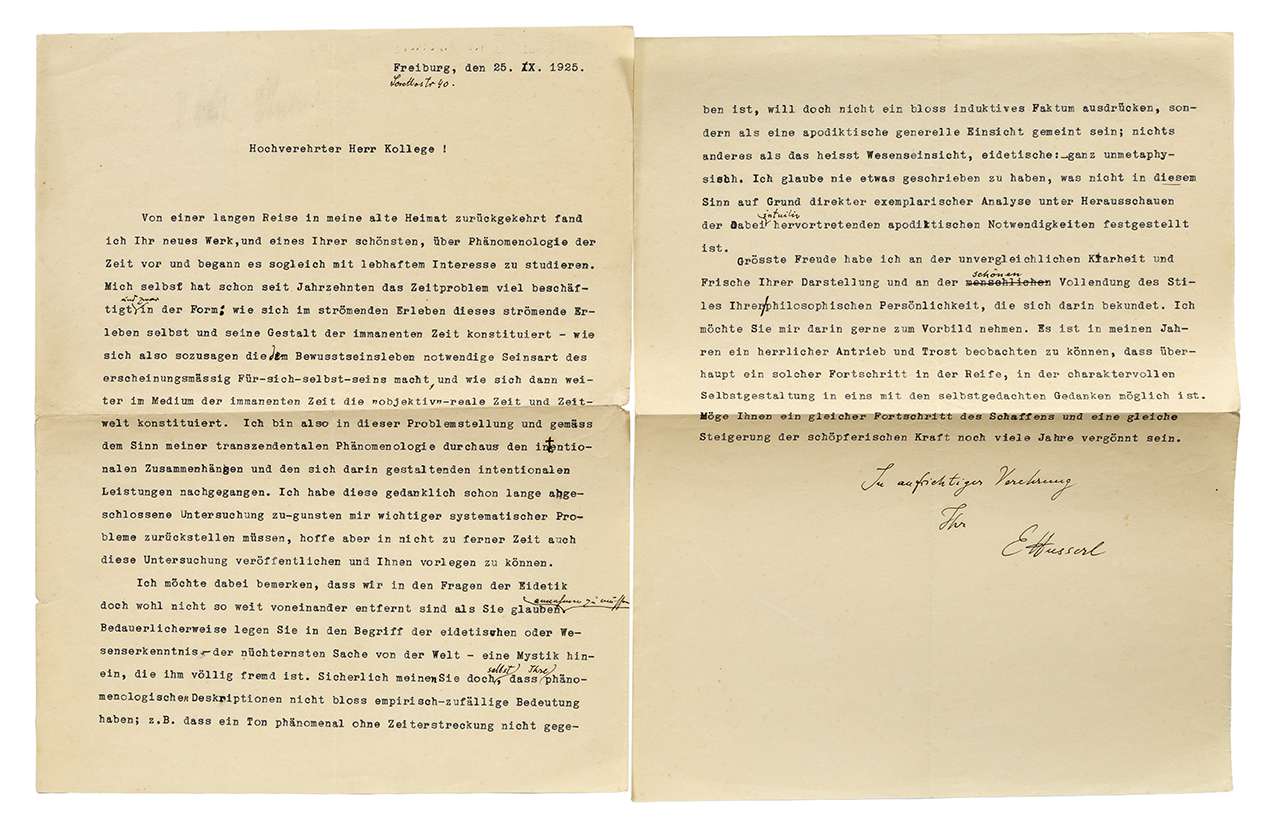
Edmund Husserl (1859–1938), philosopher, founder of phenomenology.
L.S. ‘EHusserl’ with handwritten additions and corrections, Freiburg, 25 October 1925, to a colleague [the philosopher Johannes VOLKLET]; 2 pages, folio; in German.
Fees include commission and taxes.
L.S. ‘EHusserl’ with handwritten additions and corrections, Freiburg, 25 October 1925, to a colleague [the philosopher Johannes VOLKLET]; 2 pages, folio; in German.
On returning home after a long journey, he found his colleague’s new book—one of the finest works on the phenomenology of time [Phänomenologie und Metaphysik der Zeit, 1925]—and immediately set about studying it. The problem of time had preoccupied him for decades, and chiefly what constitutes, within the lived experience of movement, this lived experience of movement itself in its aspect of immanent time—namely, how the mode of being of the individual self, necessary for the life of consciousness, presents itself, and how real objective time and the temporal world are constituted. To address this problem, he focused, following the principle of his transcendental phenomenology, on intentional sequences and the intentional acts arising from them: ‘The problem of time has preoccupied me for decades, specifically in the form: how, within the flowing experience, this flowing experience itself and its form of immanent time are constituted – that is, how, so to speak, the mode of being necessary for the life of consciousness, namely the ‘for-itself-being’ as it appears, comes into being, and how, furthermore, ‘objectively’ real time and the temporal world are constituted within the medium of immanent time. I have therefore, within this problem-setting and in accordance with the spirit of my transcendental phenomenology, thoroughly investigated the intentional connections and the intentional achievements that take shape within them »…