
&w=3840&q=75)
&w=3840&q=75)
&w=3840&q=75)
&w=3840&q=75)
&w=3840&q=75)
&w=3840&q=75)
&w=3840&q=75)
&w=3840&q=75)


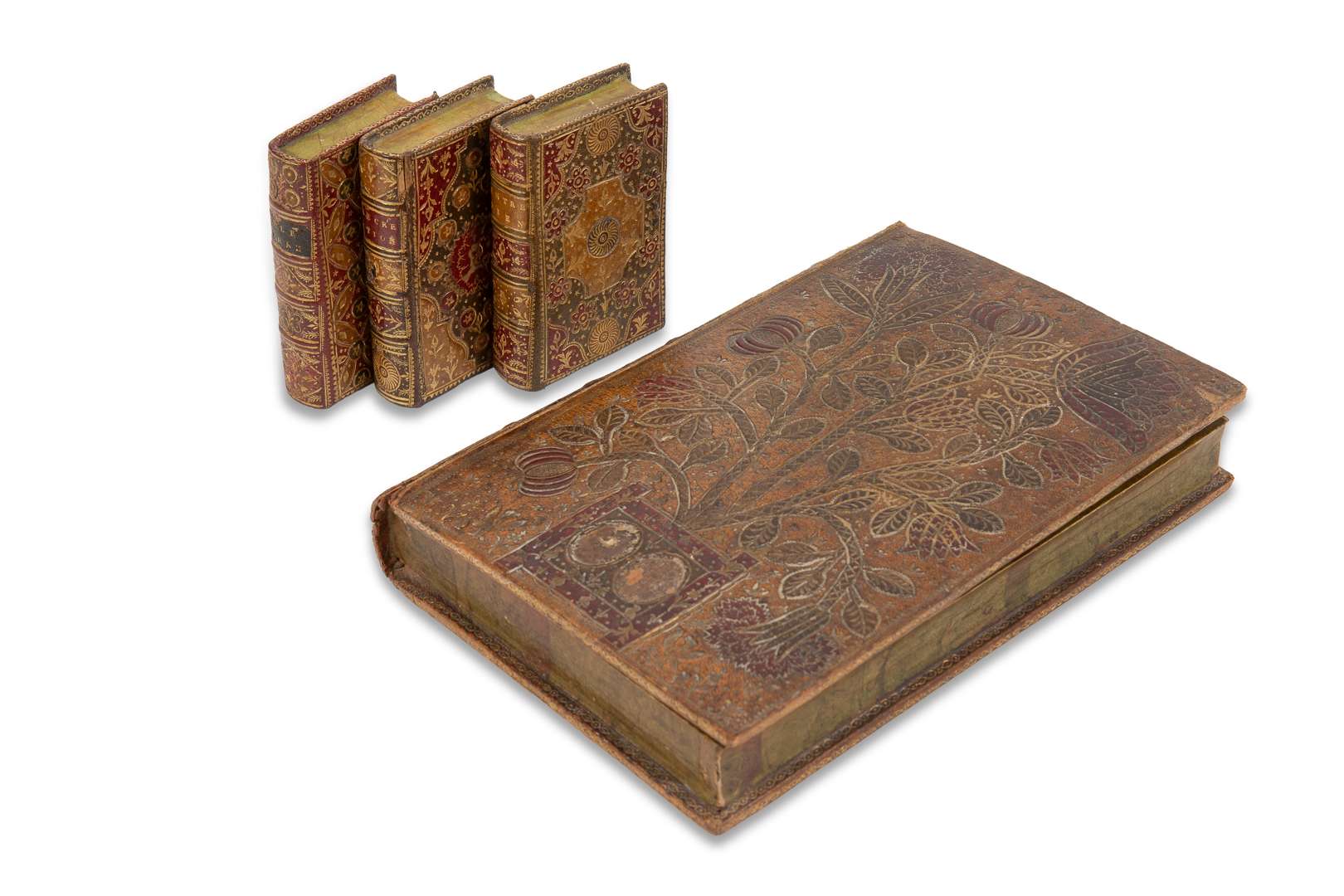
18th-century game box. PADELOUP. MOSAIC-PATTERNED MOROCCAN LEATHER.
‘A Pleasant Pastime’
(France), (c. 1750).
Fees include commission and taxes.
‘A Pleasant Pastime’
(France), (c. 1750).
In small in-4 format (16.5 x 23.5 x 3.5 cm). Mosaic morocco leather on a bistre background, decorated on both covers with a large floral motif (carnations, tulips and pomegranates) featuring a coat of arms emerging from a flower box, interspersed with small gilt ironwork depicting fluttering birds, and a fine gilt roulette pattern in the frames, a decorated ribbed spine, title label and gilt title, the back cover featuring a mosaic design in lemon morocco with a compass motif, red and green, the whole containing 4 small box-books in in-16 format (6.5 x 10 cm) decorated with maroquin leather in a mosaic compass pattern or floral motifs and containing mother-of-pearl tokens of the Pinctada spp. type, and lined with green silk (coat of arms missing, colours likely faded and gilding worn in places, upper joint slightly split at the foot over a few cm, one cover of one of the small boxes detached, a small tear in the upper cover of another, slight scuffing on the back cover).
H. Tenshert, French mosaic bindings of the 18th century, catalogue 84.
Michon, Mosaic Bookbindings of the 18th Century (1956), 51–53.
A magnificent box-bound set of games in mosaic morocco leather, attributed to Padeloup.
Of the so-called ‘tulip’ style, reminiscent of the mid-18th-century workshops specialising in floral bouquets, combined here with the so-called ‘compass games’ motif on the back cover and on three of the insets, this box is a refined, aristocratic commission evoking pleasure and the gardens of Eden, perfectly capturing the spirit of its era.
Antoine-Michel Padeloup, also known as Padeloup the Younger (1685–1758), who became bookbinder to the kings of France and Portugal, remained active until his death in 1758.
Despite the apparent rusticity of the floral design, characteristic of this style of bookbinding, this box is finely crafted, particularly in the logical repetition of the compass-drawn rosette motifs and the details of the eyelets.
The so-called ‘spinning’ or ‘whirling’ wheel is a rather characteristic motif in Padeloup’s bookbindings, which are also sometimes distinguished by a geometric interplay with the floral motifs, in keeping with the taste of the period.
This box must have been made to bear the coat of arms of a woman or a couple, which have since been removed. The joined coats of arms were inlaid within the flowerbed motif from which the bouquet springs. One might be inclined to see symbolism here: generation; flowers symbolising pure and ardent love (red carnations) or fertility (pomegranates); and an evocation of a garden or Eden, with ‘families’ of birds dotted across the covers.
The carnation motif is extremely rare in bookbinding. It appears here on the covers and as the main motif on one of the smaller boxes.
We have not been able to identify the small metal fittings featuring the eagle/flying bird, which here appears to be a female accompanied by her young; these are found at the base of the planter on both covers or scattered amongst the flowers.
The 100 tokens distributed amongst the boxes are made of engraved Pinctada spp. mother-of-pearl; they are circular or zoomorphic, featuring floral or ornithological motifs, or shaped like fish.