
&w=3840&q=75)
&w=3840&q=75)
&w=3840&q=75)
&w=3840&q=75)
&w=3840&q=75)
&w=3840&q=75)
&w=3840&q=75)
&w=3840&q=75)


DUCHESS OF BERRY. ROSNY-SUR-SEINE CASTLE.
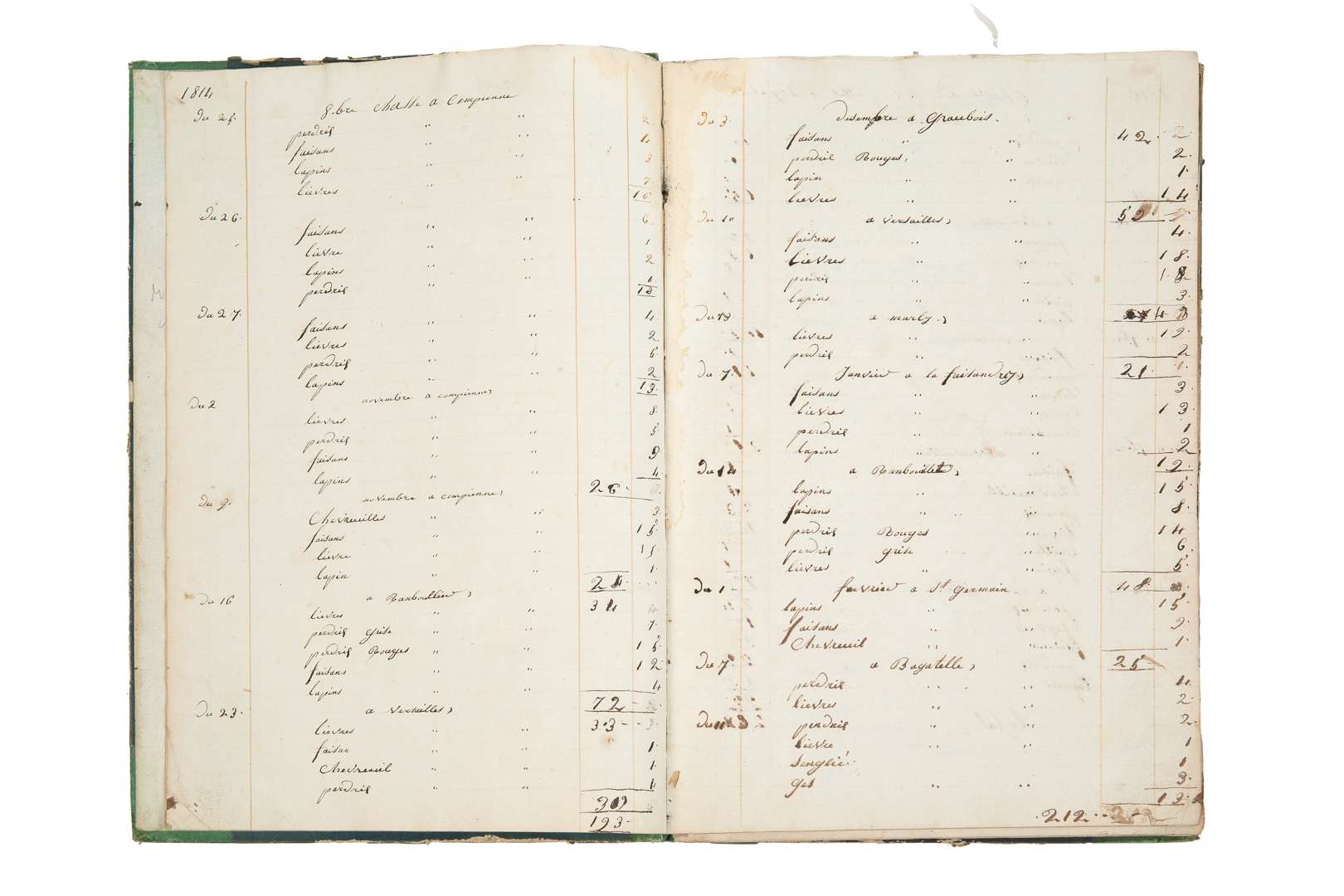
HUNTING REGISTER of His Royal Highness the Duke of Berry.
(1814–1830).
Fees include commission and taxes.
HUNTING REGISTER of His Royal Highness the Duke of Berry.
(1814–1830).
Small folio, (149) leaves. Contemporary green half-calf with corner pieces (heavily worn, with stains, discolouration, etc.).
Brown or sepia ink, hastily written, on lined paper. Notebooks left blank.
Several notes, inventory sheets and invoices slipped in over time, a handwritten note at the end regarding a hunt at Bagatelle.
The manuscript appears to have belonged to the steward of the Rosny-sur-Seine estate, which was owned by the Duchess of Berry from 1814 to 1830, as the name or signatures of a certain Molinos appear on invoices on several occasions.
Mr Molinos was responsible for the estate, which at the time comprised 1,200 hectares of woodland and numerous farms, as well as for the upkeep of the château. He was in charge of a staff comprising 36 people in 1830: 12 guards, a lamp-lighter, a fireman, a castle servant, 5 gardeners, two shipwrights, two caretakers, two doormen, a postman, two poultry girls, two pheasant-pen boys, a cart driver, two stable boys, a clockmaker and a mole catcher.
The manuscript, beginning with the hunts of the couple d’Artois and Berry, initially concerns the forests of Bagatelle and Rambouillet.
Following the assassination of Charles-Ferdinand d’Artois in February 1820, the hunts were those of the Duchess of Berry for 10 years in the forests of Rosny, Marly and St Germain, with an additional notebook.
The manuscript details the inventory of rabbits, ducks, woodcocks, partridges… a large part of which is a precise register of the game supplied (by animal, quantities…).
‘I have never been able to come to terms with the princess’s taste for hunting with a rifle. Madame de La Rochejaquelein had inspired her to take it up. These ladies would shoot rabbits, and, to identify the ones they had killed, they would cut off a piece of the ear with a small dagger they carried for that purpose and tuck this piece into the breast pocket of their jacket. On returning to the château, they would count these bloodstained trophies. It always struck me as horrible.” (Memoirs of the Countess de Boigne, née d’Osmond).
YVELINES.