
&w=3840&q=75)
&w=3840&q=75)
&w=3840&q=75)
&w=3840&q=75)
&w=3840&q=75)
&w=3840&q=75)
&w=3840&q=75)
&w=3840&q=75)


CHINA
QING DYNASTY, QIANLONG PERIOD (1736–1795)
Fees include commission and taxes.
QING DYNASTY, QIANLONG PERIOD (1736–1795)
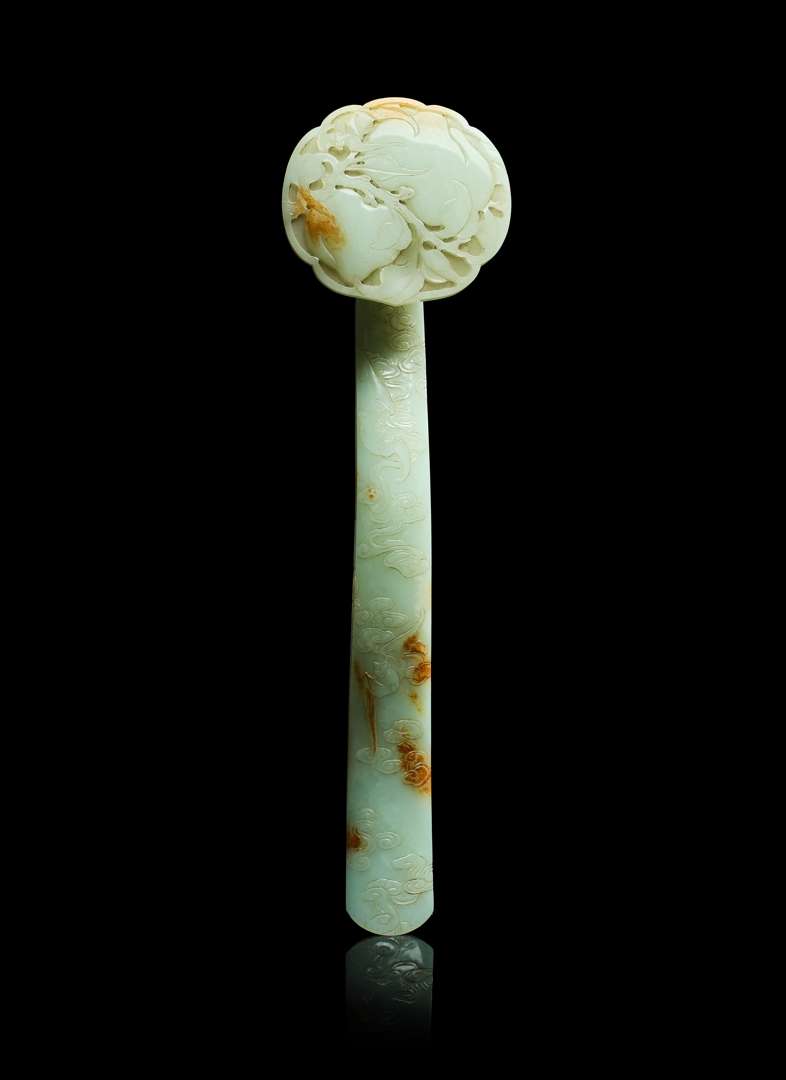
Ruyi sceptre in celadon and rust-coloured jade, the head finely decorated with a subtle relief of peaches and foliage, the handle adorned with bats and clouds.
L. 39.5 cm
Expert: Philippe Delalande Expertise – Qinghua Yin
A Parisian collection, acquired during the 1920s and 1930s (on the basis of its reputation).
The ruyi, literally ‘as you wish’, is a ceremonial sceptre whose origins date back to ancient times. During the Ming and Qing dynasties, it became one of the most prestigious emblems of the imperial court, embodying sovereign authority, the fulfilment of wishes and the most auspicious omens.
A true symbol of good fortune, the ruyi held a prominent place in imperial ceremonial life. The Qing emperors had it displayed or presented during major ceremonies, imperial birthdays and court banquets, where it expressed the ideals of a harmonious reign, prosperity and longevity. During the reign of Emperor Qianlong (1736–1795), the imperial workshops brought this art to its zenith by crafting sumptuous ruyi from jade, the most noble stone in Chinese tradition, celebrated since ancient times for its purity and the moral virtues associated with it.
The decoration, rich in symbolism, brings together the principal auspicious motifs of the Chinese repertoire: peaches, emblems of longevity, and bats, whose name is a homophone for the word ‘happiness’, together evoking bliss, prosperity and a long life. With a beautiful antique patina and remarkably well preserved, this piece bears witness to the refinement of the court arts of imperial China. It is a work of the highest quality, combining excellence of craftsmanship, rich iconography and the depth of the Chinese symbolic tradition.